
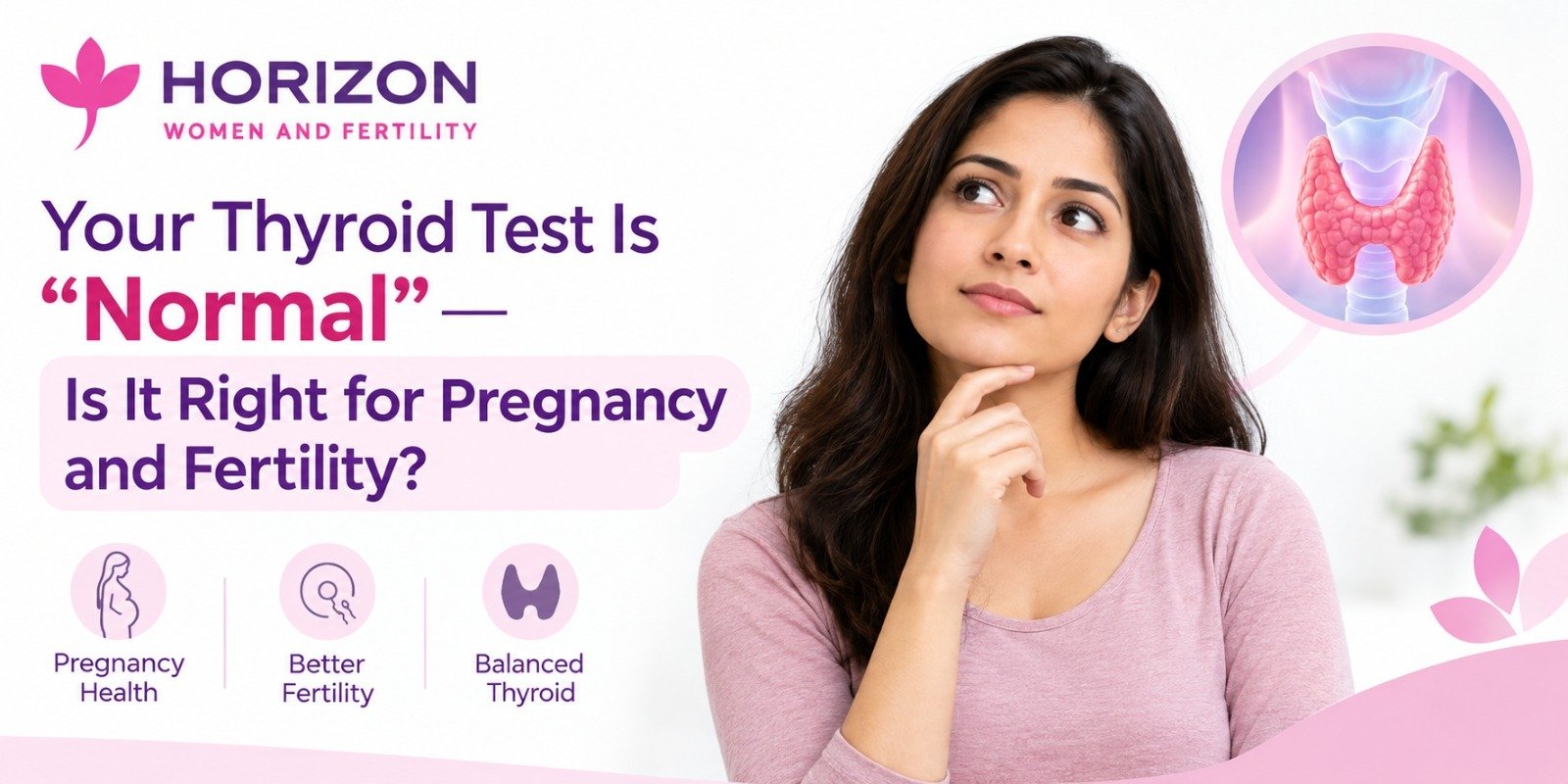
Your Thyroid Test Came Back ‘Normal’ — But Is It Optimal for Pregnancy?”
By Dr. Lavanya Bommakanti, MBBS MS(OBG) MRCOG(UK) FRM — Consultant Fertility Specialist & Gynaecologist, Horizon Women & Fertility, Banjara Hills, Hyderabad
This happens in our clinic quite often. A woman comes in for a fertility consultation. She has done her blood tests, including a thyroid test. The report says TSH 3.8 mIU/L, and the lab has marked it Normal — because the standard laboratory reference range for TSH is typically 0.5 to 5.0 or 0.5 to 4.5 mIU/L. She has been trying to conceive for over a year.
But a TSH of 3.8 is not optimal for fertility or for early pregnancy. And in the context of a woman trying to conceive or preparing for IVF, it needs to be addressed.
This is one of the most actionable things we can correct before beginning fertility treatment.
Why Thyroid Matters So Much for Fertility
The thyroid gland produces hormones — primarily T3 and T4 — that regulate metabolism throughout the body. Thyroid hormones influence:
→ Ovulation — hypothyroidism can disrupt the hormonal signalling that triggers regular ovulation, leading to irregular or absent periods
→ Egg quality and follicle development — thyroid receptors are present in the ovarian follicles themselves
→ Endometrial receptivity — the uterine lining’s ability to receive and sustain an embryo
→ Early pregnancy support — in the first trimester, before the baby’s own thyroid is functional, the developing baby relies entirely on maternal thyroid hormone for brain and neurological development
→ Miscarriage risk — abnormal thyroid function, including subclinical hypothyroidism, is associated with higher rates of early pregnancy loss
The thyroid’s role in reproduction is central. And in India, thyroid dysfunction — particularly hypothyroidism, is remarkably common in women of reproductive age.
The Difference Between “Normal” and “Optimal for Fertility”
TSH — thyroid stimulating hormone — is the main test used to assess thyroid function. When TSH is high, it means the pituitary gland is working harder to push the thyroid to produce more hormone. Standard laboratory reference ranges define normal TSH as roughly 0.5 to 4.5 or 5.0 mIU/L. These ranges are designed for the general population — they capture thyroid function adequate for daily life in someone who is not pregnant and not trying to conceive.
But fertility medicine uses a different standard. Most reproductive endocrinologists and fertility specialists — including the guidelines from ESHRE and ASRM — recommend targeting a TSH below 2.5 mIU/L before IVF and during early pregnancy. Some evidence, including a study in which women with TSH ≥ 3.4 mIU/L showed significantly poorer IVF outcomes, supports keeping levels even lower in women actively trying to conceive.
The reason is pregnancy itself. Pregnancy places enormous additional demands on the thyroid — particularly in the first trimester. A woman whose TSH is 3.5 before conception may find her thyroid function slips into overt hypothyroidism once she is pregnant, precisely at the most critical window for embryo development and early neurological formation in the baby.
Getting the thyroid into optimal territory before treatment —is a straightforward, low-risk intervention that makes a meaningful difference.
Subclinical Hypothyroidism — What It Is and Why It Matters
Subclinical hypothyroidism (SCH) is defined as a TSH above the upper limit of normal — typically above 4.0 or 4.5 mIU/L — with T3 and T4 still within normal range. The person feels well. The symptoms, if any, are subtle: mild fatigue, slightly heavier periods, a tendency toward feeling cold. Many women may have no symptoms at all.
In the general population, subclinical hypothyroidism may not require treatment in everyone.
However, coming to fertility, majority of evidence shows that subclinical hypothyroidism has a negative effect on IVF outcomes — lower implantation rates, higher early pregnancy loss. A small prospective study found that women with subclinical hypothyroidism who started levothyroxine at the beginning of their IVF cycle had higher implantation and live birth rates than untreated women. Treatment with levothyroxine is inexpensive, safe, and well-tolerated — the risk-benefit calculation strongly favours treating SCH before fertility treatment in most cases.
At Horizon Women & Fertility, if a woman comes in with a TSH above 2.5 mIU/L and is planning IVF or even natural conception, we discuss thyroid optimisation before starting treatment. This is often a small dose of levothyroxine for a few weeks before the cycle begins. But it matters.
TPO Antibodies — The Thyroid Finding Even More Women Are Missing
Thyroid Peroxidase antibodies (TPO antibodies or TPO-Ab) are markers of thyroid autoimmunity. A woman can have a completely normal TSH and still have significantly elevated TPO antibodies — meaning her immune system is attacking her thyroid tissue. This is called Hashimoto’s thyroiditis, and it is the most common cause of hypothyroidism in women of reproductive age.
We also check TPO antibodies as part of our fertility workup at Horizon Women and Fertility — not just TSH alone.
Women who are TPO-positive have a higher baseline risk of miscarriage, even when their TSH is normal. They also have approximately a 7 to 9 percent chance of developing subclinical or overt hypothyroidism during pregnancy — often silently, without symptoms — at exactly the time when thyroid hormone is most critical.
This does not mean every TPO-positive woman with normal TSH needs to be on medication. The evidence here has recently been clarified by three large, high-quality randomised controlled trials, confirmed in 2026 guidelines from the American Thyroid Association: levothyroxine does not improve fertility or reduce miscarriage rates in women who are TPO-positive but have a normal TSH.
What does matter for TPO-positive women with normal TSH is monitoring. Their thyroid function needs to be checked at the start of pregnancy and more frequently through the first trimester — because if TSH rises, early intervention is what protects the pregnancy. The benefit of treatment is in the first trimester. Starting levothyroxine later in pregnancy misses most of the potential benefit
Thyroid, PCOS, and Indian women
Thyroid dysfunction and PCOS (now PMOS) frequently coexist. Both conditions affect hormonal signalling, insulin sensitivity, and ovulation. A woman with irregular cycles and suspected PCOS who has not had her thyroid checked may have an undiagnosed thyroid disorder contributing to or worsening her symptoms. We routinely screen thyroid function alongside the standard PCOS workup.
Second, iodine deficiency – though less severe than it once was in India — and the high prevalence of autoimmune conditions in Indian women means thyroid disorders are genuinely common in the population we serve. Estimates suggest hypothyroidism affects 10 to 15 percent of Indian women of reproductive age, with subclinical hypothyroidism considerably more prevalent than that.
Thyroid and Recurrent Miscarriage
If you have experienced two or more miscarriages, thyroid function — including TPO antibodies — should be part of your investigation. Undiagnosed subclinical hypothyroidism and thyroid autoimmunity are both associated with recurrent pregnancy loss. In a woman who has miscarried repeatedly with no identified cause, optimising thyroid function before the next attempt is one of the most accessible and evidence-supported interventions available.
At Horizon Women and Fertility, thyroid evaluation is part of our standard RPL (recurrent pregnancy loss) workup.
What to Ask Your Doctor
If you are trying to conceive, planning IVF, or have experienced recurrent miscarriage, these are the thyroid questions worth raising:
→ What is my TSH, and is it below 2.5 mIU/L — the fertility threshold, not just the general normal range?
→ Have my TPO antibodies been checked?
→ If my TSH is between 2.5 and 4.5 — technically normal but not optimal — should I consider a small dose of levothyroxine before starting treatment?
→ If I am TPO-positive with normal TSH, how will my thyroid be monitored once I conceive?
→ Does my thyroid history explain any of my irregular cycles or previous pregnancy losses?
How We Approach Thyroid at Horizon Women & Fertility
At Horizon Women & Fertility, thyroid screening — TSH and TPO antibodies — is part of our standard pre-IVF blood panel. It sits alongside AMH, hormonal workup, vitamin D, insulin, and the rest of the investigations we complete before recommending any treatment.
The reason being- thyroid dysfunction is a common, correctable, and consequential concern.
In fertility medicine, getting the basics completely right before treatment begins often makes the difference between a cycle that succeeds and one that doesn’t.
Horizon Women and Fertility | Plot 723, Road No. 1, Banjara Hills, Hyderabad 500034 | +91 80194 25500 | horizonwomenandfertility.com | Mon–Sat: 8am–8pm