
All My Fertility Tests Are Normal Why Can’t I Get Pregnant?
“Doctor, all my reports are normal. Then why am I still not pregnant?”
This is one of the most common concerns couples share during their fertility journey. Seeing normal blood tests, hormone levels, ultrasound scans, ovulation reports, and semen analysis can be reassuring but it can also be confusing when pregnancy still doesn’t happen.
At Horizon Women & Fertility, Banjara hills at Hyderabad ,recognized by many couples as a best fertility hospital for personalized reproductive care, Dr. Lavanya Bommakanti Fertility Expert believes fertility is much more than a collection of normal reports. Every couple deserves a thorough evaluation because fertility depends on several biological processes that routine investigations cannot always detect. At Horizon Fertility Center, our focus is on identifying the underlying cause and creating an individualized treatment plan based on your unique fertility journey rather than simply treating test results.
Can You Have Normal Fertility Tests and Still Not Get Pregnant?
Yes.
It is entirely possible to have normal fertility investigations and still experience difficulty conceiving. This condition is known as unexplained infertility.
The term doesn’t mean there is no problem—it simply means that standard fertility tests have not identified the exact reason.
Modern reproductive medicine has shown that successful pregnancy involves many microscopic and complex biological events that cannot always be measured through routine investigations.
Approximately 15–30% of infertility cases are categorized as unexplained infertility, depending on age and clinical evaluation.
What Is Unexplained Infertility?
A diagnosis of unexplained infertility is considered when:
- Ovulation is normal.
- Fallopian tubes are open.
- The uterus appears structurally normal.
- Semen analysis falls within normal limits.
- Hormone tests are satisfactory.
- Pregnancy has not occurred despite regular, unprotected intercourse.
Although no obvious abnormality is identified, subtle reproductive issues may still exist.
Why Pregnancy May Not Happen Despite Normal Reports
Pregnancy requires several perfectly timed biological events. Even a small disruption can reduce the chances of conception.
1. Egg Quality May Not Match Egg Quantity
Many women undergo an AMH (Anti-Müllerian Hormone) test.
While AMH estimates ovarian reserve, it does not assess egg quality.
A woman may have an adequate number of eggs, but the genetic quality of those eggs naturally declines with age, affecting fertilization and embryo development.
2. Sperm Can Appear Normal but Function Abnormally
Routine semen analysis evaluates:
- Sperm count
- Motility
- Morphology (shape)
However, sperm health is much more complex.
Issues such as:
- DNA fragmentation
- Oxidative stress
- Fertilization defects
may not be identified during a standard semen analysis.
In selected patients, additional male fertility investigations may provide valuable information.
3. Ovulation Timing May Not Be Accurate
Many couples rely on:
- Period tracking apps
- Calendar methods
- Ovulation predictor kits
While useful, these methods aren’t always perfectly accurate.
Some women ovulate:
- Earlier than expected
- Later than expected
- At varying times every cycle
Ultrasound follicular monitoring provides much more precise ovulation assessment when clinically indicated.
4. Fertilization Is a Highly Complex Process
Even if both egg and sperm are healthy, fertilization still requires several microscopic events.
The sperm must:
- Reach the egg
- Penetrate its outer layer
- Successfully fertilize it
Any subtle problem during this stage usually cannot be detected through routine investigations
5. Implantation Is More Complicated Than It Seems
Successful fertilization does not always guarantee pregnancy.
The embryo must implant successfully into the uterine lining.
Implantation depends on:
- Healthy endometrium
- Proper hormonal support
- Good embryo quality
- A receptive uterine environment
Many implantation-related factors remain difficult to evaluate using basic fertility tests.
6. Mild Endometriosis Can Be Missed
Not every woman with endometriosis experiences severe pain.
Some women have mild disease that primarily affects fertility while causing very few symptoms.
Superficial endometriosis often cannot be detected on routine ultrasound.
Your symptoms and medical history frequently provide important clues.
7. Small Uterine Abnormalities May Go Undetected
Routine scans may occasionally miss:
- Small uterine polyps
- Mild adhesions
- Uterine septum
- Chronic endometrial inflammation
Depending on individual circumstances, your fertility specialist may
recommend:
- Hysteroscopy
- Saline infusion sonography
- Advanced imaging
for further evaluation.
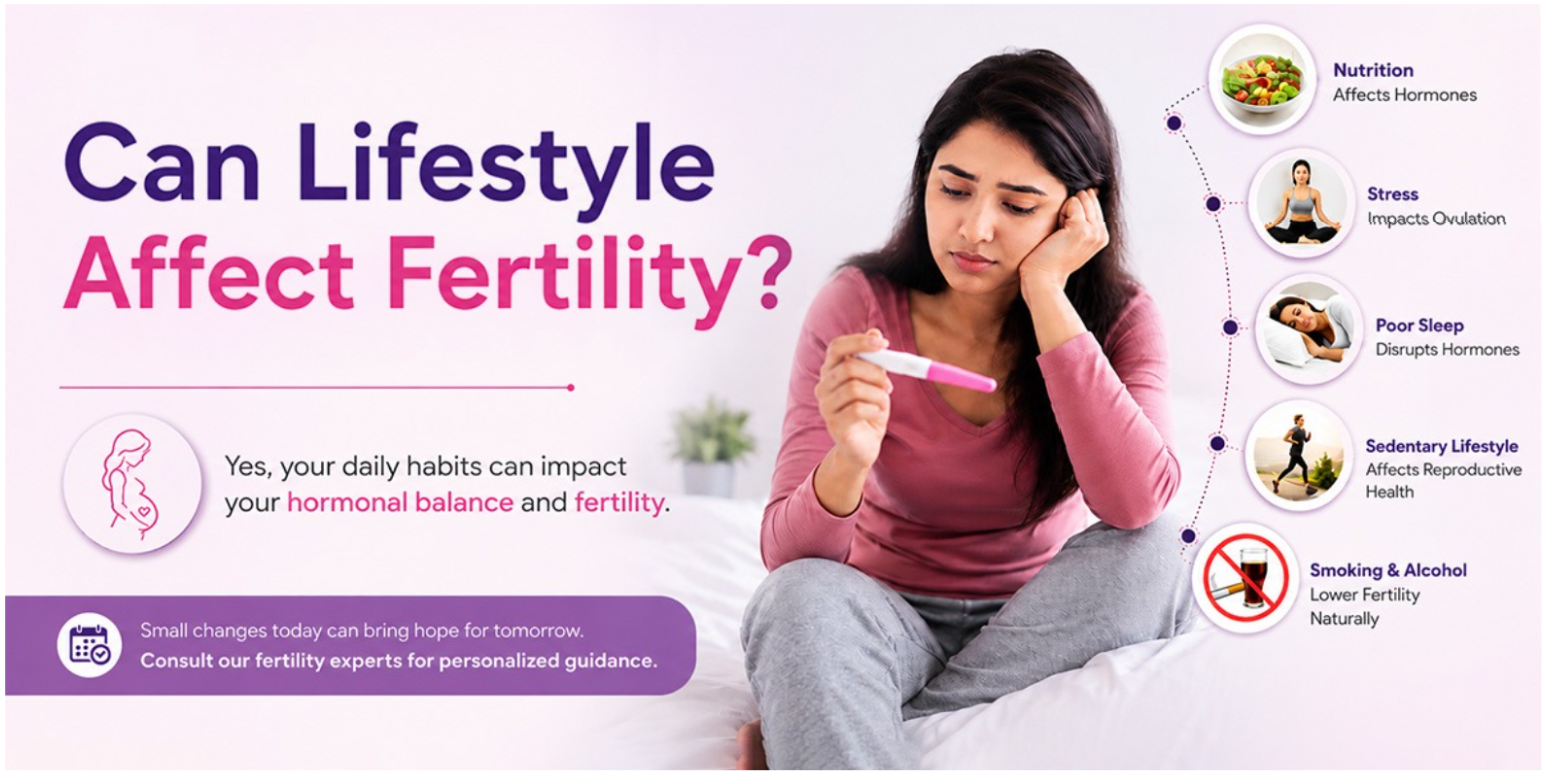
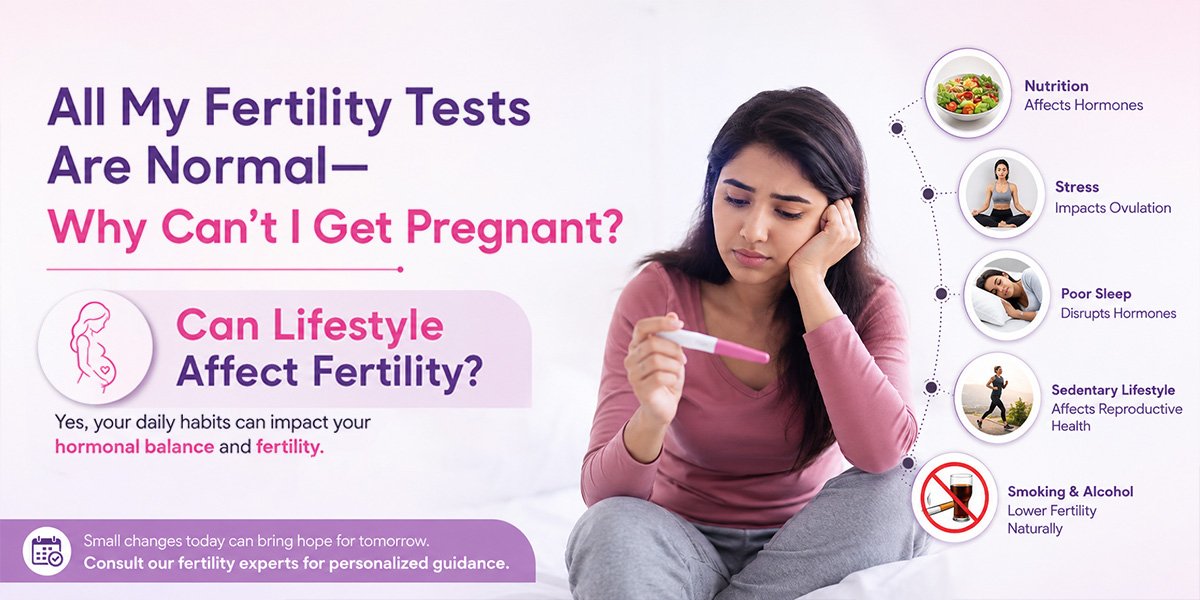
Can Lifestyle Affect Fertility?
Yes.
Lifestyle may not be the only reason for infertility, but it can significantly influence reproductive health.
Factors that may reduce fertility include:
- Smoking
- Excess alcohol consumption
- Obesity
- Being underweight
- Poor sleep
- Chronic stress
- Poorly controlled diabetes
- Thyroid disorders
Healthy lifestyle changes often improve overall reproductive health and support fertility treatments.
When Should You See a Fertility Specialist?
You should consider a fertility evaluation if:
- You’re under 35 and have been trying for 12 months
- You’re 35 or older and have been trying for 6 months
- Your menstrual cycles are irregular
- You experience severe period pain
- You have known endometriosis
- You’ve had recurrent miscarriages
- Your partner has male fertility concerns
- You’ve undergone pelvic surgery, chemotherapy, or radiation
Early evaluation helps identify potential problems before valuable time is lost.
Does Unexplained Infertility Mean You Need IVF?
Absolutely not.
Many couples assume IVF is the only solution—but that’s a misconception.
Treatment depends on:
- Age
- Duration of infertility
- Ovarian reserve
- Previous treatments
- Overall reproductive health
- Individual fertility goals
Depending on your evaluation, treatment may include:
- Lifestyle optimization
- Timed intercourse
- Ovulation induction
- Intrauterine insemination (IUI)
- IVF or ICSI, when appropriate
The right treatment is based on your individual circumstances—not simply the label of unexplained infertility.
Why a Comprehensive Fertility Assessment Matters
Fertility is much more than laboratory values.
A complete fertility assessment includes:
- Detailed medical history
- Menstrual cycle evaluation
- Ultrasound findings
- Previous pregnancies
- Lifestyle assessment
- Male partner evaluation
- Review of previous fertility investigations
This holistic approach often uncovers important factors that routine testing may overlook.
Why Choose Horizon Women & Fertility?
Choosing the best fertility center is about more than advanced technology—it’s about receiving personalized, ethical, and evidence-based care.
At Horizon Women & Fertility, every couple receives a comprehensive fertility assessment designed to identify both obvious and hidden causes of infertility. Led by Dr. Lavanya Bommakanti, Consultant Fertility Specialist and Gynecologist with over 15 years of experience, the center offers advanced fertility evaluation, IUI, IVF, ICSI, fertility preservation, reproductive ultrasound, hysteroscopy, laparoscopy, and expert management of conditions such as PCOS, endometriosis, recurrent pregnancy loss, and male fertility concerns.
Why couples trust Horizon Women & Fertility:
- Comprehensive evaluation for both partners
- Personalized treatment plans tailored to individual needs
- Advanced fertility diagnostics and modern reproductive technologies
- Ethical, transparent, evidence-based care
- Compassionate guidance throughout every stage of treatment
- Expertise in managing complex fertility conditions
- State-of-the-art fertility and gynecology services under one roof
Whether you need advanced fertility treatment, Horizon Women & Fertility is committed to helping you make informed decisions with confidence.
Take the Next Step Toward Parenthood
If you’ve been trying to conceive and your reports are normal, don’t lose hope. Normal test results don’t always tell the complete story.
A comprehensive fertility evaluation can identify hidden factors affecting conception and guide you toward the most appropriate treatment—whether that’s continued natural conception, lifestyle modifications, IUI, IVF, or simply reassurance.
At Horizon Women & Fertility, every fertility journey begins with understanding your complete picture not just your reports. With expert care from Dr. Lavanya Bommakanti, advanced diagnostic facilities, personalized treatment plans, and compassionate support, you receive the clarity and confidence needed to take the next step toward parenthood.
Frequently Asked Questions
-
Yes. Routine fertility investigations cannot identify every factor involved in conception. Some causes only become evident after specialized evaluation.